

Alphabet Q3 2026 results: Google Cloud doubles to $30.7 billion as capex reaches $51.4 billion and free cash flow turns negative
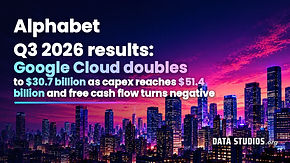
Alphabet reported third-quarter 2026 results on October 28 that put two numbers side by side: Google Cloud revenue of $30.7 billion, more than double the $15.2 billion of a year earlier, and capital expenditures of $51.4 billion, more than double the $24.0 billion spent in the third quarter of 2025. Total revenue rose 25% to $127.6 billion, consolidated operating income rose 30% to $40.6 billion, and Sundar Pichai said in the earnings release that the company is "now on a half-trillion dollar revenue run rate."
The same release shows the cost of that growth. Net cash from operating activities fell to $42.3 billion from $48.4 billion, which, after $51.4 billion of purchases of property and equipment, left Alphabet with negative free cash flow of $9.1 billion for the quarter, its second consecutive negative quarter after minus $5.9 billion in the second quarter. Net income fell 24% to $26.5 billion and diluted earnings per share fell to $2.12 from $2.87, driven largely by an $8.7 billion loss on equity securities that compares with a $10.7 billion gain a year earlier.
The market read the quarter as a question about the return on AI spending. Alphabet's Class A shares closed at $283.82 on Thursday, October 29, down 12.64% on the day, even though the operating business grew and Google Cloud more than doubled its revenue. For the people who build on Gemini models and Google Cloud infrastructure, the figures say less about the share price and more about where Google is putting capacity, how quickly AI demand is being converted into revenue, and how far the company is willing to stretch its balance sheet to keep up.
··········
GOOGLE CLOUD REVENUE AND PROFIT MORE THAN DOUBLE.
Google Cloud revenue reached $30,709 million in the quarter, up from $15,157 million in the third quarter of 2025, an increase of about 103% that Pichai attributed to "huge demand for our AI infrastructure and AI solutions." Cloud now accounts for roughly 24% of Alphabet's total revenue, compared with about 15% a year ago, which is the clearest measure of how quickly the company's revenue mix is shifting away from advertising.
Profitability moved even faster than revenue. Google Cloud operating income rose to $11,121 million from $3,594 million, roughly a threefold increase, and the segment's operating margin widened from about 23.7% to about 36.2%. That margin expansion matters because it answers a common objection to cloud AI growth, namely that GPU- and accelerator-heavy workloads are sold at thin margins to win share. On Alphabet's reported segment numbers, the opposite happened this quarter: incremental Cloud revenue came with a higher margin than the existing base, and Cloud produced about 27% of Alphabet's consolidated operating income.
In his remarks on the earnings call, Pichai said demand for TPU systems is strong across a wide range of customers, that he expects that to continue, and that Google is "working hard to bring more capacity online." He also said first-party model APIs now process nearly 32 billion tokens per minute, up 40% from the previous quarter and more than four times the level of a year earlier. Alphabet did not publish a Cloud revenue backlog figure in the release, and the CEO remarks also do not include one, so the size of contracted but unrecognized Cloud revenue at the end of September is not part of the verified record here.
........
Line ($ millions) | Q3 2025 | Q3 2026 | Change |
Google Search & other | 56,567 | 63,350 | +12.0% |
YouTube ads | 10,261 | 11,207 | +9.2% |
Google Network | 7,354 | 7,455 | +1.4% |
Subscriptions, platforms and devices | 12,870 | 14,290 | +11.0% |
Google Services total | 87,052 | 96,302 | +10.6% |
Google Cloud | 15,157 | 30,709 | +102.6% |
Other Bets | 344 | 372 | +8.1% |
Total revenues | 102,346 | 127,577 | +24.7% |
........
··········
SEARCH, YOUTUBE AND SUBSCRIPTIONS GROW AT A SLOWER PACE.
Outside Cloud, the picture is one of steady but much slower growth. Google Search & other revenue rose 12.0% to $63.4 billion, YouTube ads grew 9.2% to $11.2 billion, and Google Network revenue was nearly flat at $7.5 billion. Total Google advertising revenue reached $82.0 billion, up 10.6%, and Google subscriptions, platforms and devices grew 11.0% to $14.3 billion. Taken together, Google Services revenue grew 10.6% to $96.3 billion, while Services operating income rose 16.8% to $39.2 billion, lifting the segment's margin from about 38.5% to about 40.7%.
Pichai used the call to argue that AI is expanding rather than cannibalizing Search. He said year-over-year growth in Search queries is "the highest it's been in the last five years," that AI Mode queries are on average three times longer than traditional searches, that one in five AI Mode searches globally uses voice, images or documents, and that Google has crossed 50 billion visual searches per month. These are usage claims made by the company, not audited financial figures, and Alphabet did not disclose how much revenue AI Mode itself generates or how ad load in AI Mode compares with classic results pages.
On subscriptions, Pichai said YouTube Music and Premium passed 150 million subscribers globally, including trials. The release does not break out Google One or Gemini subscription revenue separately, so the contribution of paid AI plans to the $14.3 billion subscriptions, platforms and devices line cannot be isolated from the published numbers.
··········
GEMINI USAGE, MODELS AND WHAT THE CALL SAID ABOUT CAPACITY.
The product metrics Alphabet chose to highlight were mostly about Gemini. Pichai said the Gemini app now has one billion users, with the accompanying infographic describing them as more than one billion monthly active users, and called it "the fastest-growing product in Google's history." He said developer usage of Gemini 4 Argon, launched about two weeks before the call, ramped 3.5 times faster in its first week than Gemini 3 had, "even with capacity constraints," and that internal teams across Chrome, Ads and Search used Argon to ship 35% more code with 30% fewer errors. Those internal productivity figures are company statements without a published methodology.
The call also coincided with the announcement of Gemini 4 Carbon, which Pichai described as Google's strongest frontier model and which is rolling out first to a subset of trusted cyber defenders while being tested by the U.S. government. Pichai cited a score of 59 on the Artificial Analysis Intelligence Index, an independent aggregate benchmark, and said Carbon outperforms Argon in almost every domain. He added that Google plans to bring the agentic features first launched in its enterprise Gemini agent to Search and the Gemini app, and then to Chrome, Android and Workspace, without giving dates.
The phrase "capacity constraints" is the most practically relevant line of the call for developers. It confirms that demand for Google's newest models outran available serving capacity at launch, which is consistent with the capex numbers below. It also explains why a staged rollout, as with Carbon, is likely to remain Google's pattern for the most compute-intensive models while new data centers and TPU systems come online.
··········
CAPEX OF $51.4 BILLION AND NEGATIVE FREE CASH FLOW.
Purchases of property and equipment reached $51,355 million in the third quarter, up 114% from $23,953 million a year earlier and equal to about 40% of quarterly revenue. Over the trailing twelve months through September, Alphabet generated $179.6 billion of operating cash flow and spent $159.8 billion on capital expenditures, leaving trailing free cash flow of $19.7 billion. On a quarterly basis, free cash flow moved from $24.6 billion in the fourth quarter of 2025 to $10.1 billion in the first quarter of 2026, minus $5.9 billion in the second quarter and minus $9.1 billion in the third.
........
Cash flow ($ millions) | Q3 2025 | Q3 2026 |
Operating cash flow | 48,414 | 42,290 |
Capital expenditures | (23,953) | (51,355) |
Free cash flow | 24,461 | (9,065) |
Share repurchases | (11,504) | 0 |
Dividends paid | (2,537) | (2,936) |
........
Alphabet financed the gap with debt and equity rather than cash on hand. The release reports $28.7 billion of net proceeds from senior unsecured notes issued in the quarter, and sales under an at-the-market program of 12 million Class A shares for $4.3 billion net and 24 million Class C shares for $8.1 billion net, with $27.6 billion still available under the program. Long-term debt rose to $125.1 billion at September 30 from $46.5 billion at the end of 2025, and quarterly interest expense rose to $967 million from $143 million a year earlier. The company also pays dividends on a mandatory convertible preferred stock, which cost $298 million in the quarter.
Share repurchases stopped entirely. Alphabet bought back $11.5 billion of stock in the third quarter of 2025 and $39.8 billion in the first nine months of last year, against zero in both periods of 2026. The common dividend continues: the board declared $0.22 per share, payable on December 14, 2026, to holders of record on December 7. The release does not include a new full-year capital expenditure outlook, and no forward capex figure is part of the verified record for this article.
Property and equipment, net, reached $372.8 billion at September 30, up from $246.6 billion at the end of 2025, and total assets crossed $1 trillion, at $1,003.3 billion. Those balance-sheet figures show the physical scale of the build-out: in nine months, Alphabet added more than $126 billion of net property and equipment, most of it, by the company's own description of its spending, data centers and computing infrastructure.
··········
WHY NET INCOME FELL WHILE OPERATING INCOME ROSE.
The 24% decline in net income does not come from the operating business. Income from operations rose to $40,576 million from $31,228 million, and the operating margin edged up to 31.8%. The swing happened below the operating line, where other income and expense moved from a $12,759 million gain in the third quarter of 2025 to an $8,221 million loss this year.
The largest component was an $8,664 million net loss on equity securities, compared with a $10,734 million gain a year earlier. Alphabet states that this loss reduced its tax provision by $1.9 billion, net income by $6.7 billion and diluted EPS by $0.55. Adding the $6.7 billion back would put net income at roughly $33.2 billion, still slightly below the $35.0 billion of a year earlier, because the year-ago figure also contained a large unrealized gain. Debt securities produced a $383 million loss and higher interest expense took a further $824 million more than in the prior-year quarter.
Costs inside the operating line grew quickly as well. Research and development expenses rose 36% to $20.6 billion and cost of revenues rose 24% to $51.4 billion, reflecting depreciation and the cost of serving AI workloads. Alphabet-level activities, which include costs the company does not allocate to segments, widened to a $7,655 million loss from $4,467 million, and the release says this line includes severance, office space reduction charges and certain fines and settlements, without giving amounts. Other Bets lost $2,047 million at the operating level, compared with $1,426 million a year earlier. Headcount reached 204,757, up 7.7% from 190,167.
........
Profit and margins | Q3 2025 | Q3 2026 |
Income from operations ($M) | 31,228 | 40,576 |
Google Services operating margin | 38.5% | 40.7% |
Google Cloud operating margin | 23.7% | 36.2% |
Other income (expense), net ($M) | 12,759 | (8,221) |
Net income ($M) | 34,979 | 26,468 |
Diluted EPS | $2.87 | $2.12 |
........
··········
WHAT CHANGES FOR GOOGLE CLOUD CUSTOMERS AND GEMINI DEVELOPERS.
For companies buying Google Cloud capacity or building on the Gemini API, three points in the results are directly practical. The first is that Google is spending at a rate that signals it expects demand for its accelerators and model APIs to keep growing, which supports the availability of TPU capacity and new model tiers over the next several quarters. The second is that capacity is, by the CEO's own account, still the binding constraint, so customers should expect gated or staged launches for the most demanding models and should plan quotas and rate limits accordingly rather than assuming unlimited on-demand capacity at launch.
The third point concerns pricing power. A Cloud operating margin above 36% indicates that Google is not currently pricing AI infrastructure at a loss to win share. That does not, on its own, say anything about future list prices, and the earnings materials contain no pricing announcements, but it does mean that recent price levels for Gemini models and TPU capacity are consistent with healthy segment profitability rather than subsidy. Developers comparing providers can read the Cloud numbers alongside Amazon's third-quarter results, where AWS grew 39% to $46 billion: Google Cloud is smaller in absolute revenue but is growing far faster on the published figures.
For consumers, the numbers mostly confirm direction rather than change anything immediately. The Gemini app's reported one billion users, the plan to bring agentic features to Search, the Gemini app, Chrome, Android and Workspace, and the continued investment in AI Mode indicate that Gemini features will keep spreading across Google's products. None of the earnings materials announce changes to consumer plans, prices or usage limits.
··········
WHAT IS ESTABLISHED AND WHAT REMAINS UNCERTAIN.
The reported figures in the release establish several facts clearly. Google Cloud more than doubled its revenue to $30.7 billion and roughly tripled its operating income to $11.1 billion. Total revenue grew 25% to $127.6 billion and operating income grew 30% to $40.6 billion. Capital expenditures more than doubled to $51.4 billion, free cash flow was negative by $9.1 billion for the second negative quarter in a row, buybacks were suspended, and long-term debt reached $125.1 billion. Net income fell 24% mainly because of an $8.7 billion loss on equity securities.
Several important questions remain open on the published record. Alphabet has not provided an updated capex outlook in the release, has not disclosed a Cloud backlog figure in the materials reviewed, and does not separate Gemini subscription or API revenue from broader segments, which makes it impossible to measure directly how much of the Cloud surge comes from model APIs versus TPU and GPU infrastructure rented to other AI developers. Usage metrics such as the one billion Gemini app users, the 32 billion tokens per minute and the internal productivity gains are company statements rather than independently verified figures.
The financial tension that moved the share price is real but narrower than the headline net income suggests. The operating business is growing faster and at higher margins than a year ago; what has changed is that Alphabet now spends more on infrastructure than it generates in operating cash flow and funds the difference with bonds, preferred stock and share sales. Whether that trade pays off depends on whether the Cloud growth rate and margin seen this quarter persist once the new capacity is online, a question that the next several quarterly reports, not this one, will answer.
··········
FOLLOW US FOR MORE.
·····
DATA STUDIOS
·····
datastudios.org


