

GitHub launches its AI app-making tool in public preview: “Spark” promises idea-to-deployment prototypes in minutes
- Jul 23, 2025
- 2 min read

GitHub has opened the doors to Spark, a Copilot-native environment that transforms natural-language prompts into fully functional applications. Announced 24 July 2025 and immediately available to Copilot Pro Plus subscribers, the tool lets developers and non-coders alike generate, test, and deploy web or mobile apps with a single conversational workflow. Spark is the third pillar of GitHub’s Copilot portfolio, sitting beside Copilot Chat and Copilot Workspace yet covering the entire software-development life cycle—from scaffold to one-click deployment.
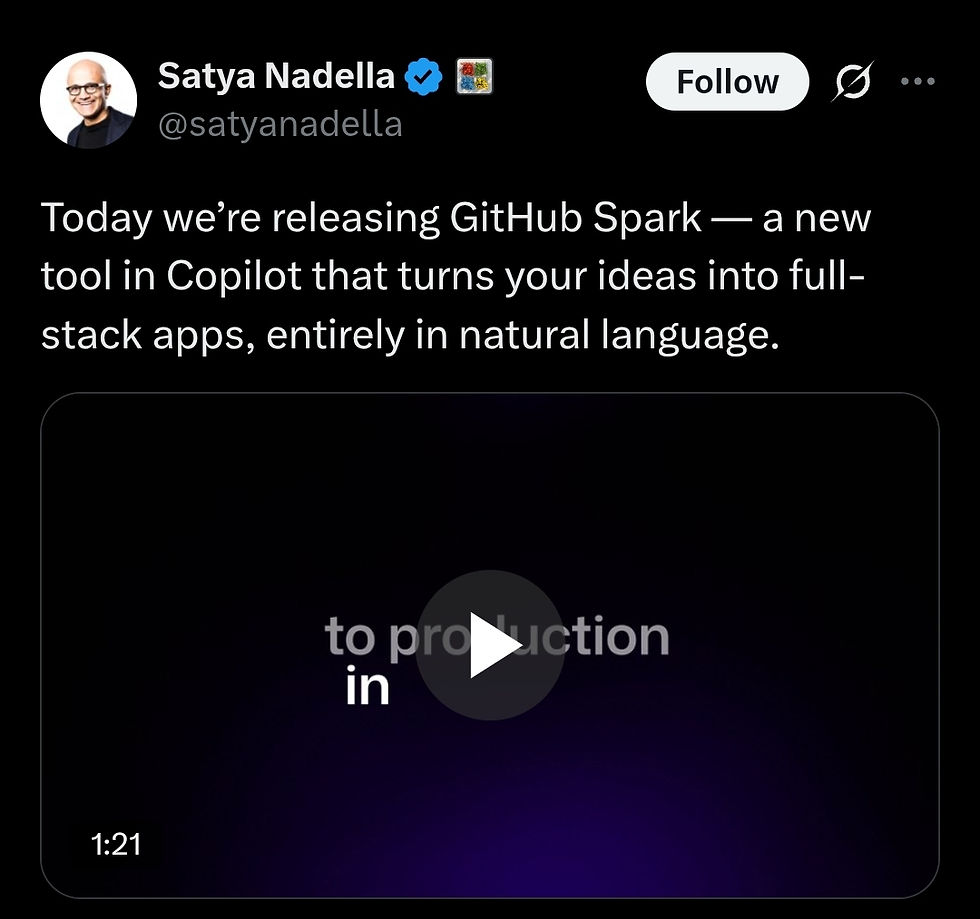
Spark converts plain-English ideas into working code across popular stacks.
Users begin by describing their project in ordinary language—“Build a climate-data dashboard in Next.js” or “Create a React Native expense tracker for iOS and Android.” Spark then asks for a preferred stack and spins up a repository containing front-end components, back-end routes, environment files, tests, and CI scripts. Within seconds, it launches a live preview workspace where users can interact with the running app, inspect code, and open a chat panel for iterative refinements.
The underlying engine is multi-model by default. GitHub ships Spark with Anthropic’s Claude Sonnet 4 as the primary model but offers a dropdown for GPT-4o, Gemini 1.5 Pro, Llama 3 70B, xAI Grok 3.5, and DeepSeek-Coder. Every change—refactors, new features, or API integrations—is committed to a side branch, preserving a clean history and making it easy to trace Spark’s contributions line-by-line.
The workflow moves beyond pair programming into full SDLC automation.
While Copilot Chat accelerates in-IDE coding and Workspace helps plan multi-file changes, Spark tackles the complete SDLC loop. After scaffolding, the assistant can generate Jest or Playwright tests, configure GitHub Actions for CI, and draft a changelog. A “One-click Deploy” button pushes the artifact to Vercel, Azure Static Web Apps, or AWS Amplify; GitHub lists Hugging Face Spaces and Meta Threads Apps as upcoming targets. For teams, Spark supports real-time preview links and branch protection, allowing product managers or designers to leave inline feedback without leaving the browser.
Access tiers, pricing mechanics, and the preview roadmap are now public
Spark is live today for Copilot Pro Plus customers ($39 per user per month) and will roll out to free-tier developers via wait-list invitations through September. During preview, Spark’s compute costs draw down from the same context-token pool that powers Copilot Chat; post-GA billing will add a separate “Spark compute” meter for heavy deployment or lengthy training jobs.
GitHub’s blog outlines several features slated for the next milestones: collaborative, Google-Docs-style editing; Figma import that turns design files into React components; and an auto-generated README-and-license wizard to ease open-source publication.
GitHub positions Spark as an on-ramp for the next wave of software creators
The company frames Spark as the bridge for the “next 100 million developers.” Product owners, domain experts, and students can convert ideas into running software without deep coding experience, while senior engineers gain a rapid-prototyping sandbox that exports clean, editable repos. By integrating model-agnostic generation directly into GitHub’s code host, CI/CD, and deployment ecosystem, Spark sets a new competitive baseline that Google’s Project IDX, Replit’s Ghostwriter, and the forthcoming VS Code agent templates will have to match.
_____
FOLLOW US FOR MORE.
DATA STUDIOS


